
Click to go home - Alaska Fly Fishing

The Upper Base Camp
The Kanektok River Orientatation Letter


Where We Fish in Alaska
Rates and Dates
What our Guests Say
Fishing Reports
Weather Reports
Stories and Articles New story
Frequent Questions
Why Fish with Us
Contact Us
Links
Meet the Duncans
Meet the Guide Staff
Quinhagak
Photo Galleries
Virtual Trip - UBC
Virtual Trip - LBC NEW
Costa Rica
Home

Dave Duncan and Sons
Guest Written Orientation
Kanektok River Upper Base Camp


Please take some time to read this Orientation as it is designed to give you a better understanding about your up coming trip to our Upper Base Camp in the Togiak National Wildlife Refuge (TNWR). We recommend that you keep this letter and reread it just prior to your trip. Dave Duncan and Sons has been operating within the TNWR since before it was established in 1982. The TNWR is an extremely unique area that provides some of the best fishing and wilderness opportunities available today. We should all feel privileged to experience an area that is as unique and unchanged as the TNWR is.

The TNWR was established by the U. S. Fish and Wildlife Service to be managed for the purposes:

1. To conserve fish and wildlife populations and habitats in their natural diversity including, but not limited to, salmonnoids, marine birds and mammals, migratory birds and large mammals (including their restoration to historic levels).

2. To fulfill the international treaty obligations of the United States with respect to fish and wildlife and their habitats.

3. To ensure, in the manner consistent with purposes set forth in subparagraphs (1) and (2), the opportunity for continued subsistence uses by local residents.

4. To ensure, to the maximum extent practicable, and in the manner consistent with the purposes set forth in subparagraph (1), water quality and necessary water quantity within the refuge.

Although none of the refuge purposes relate directly to providing for recreation uses of TNWR, they do provide standards for establishing public use goals and objectives. The goal of the public use program at TNWR is to provide high quality lands and wildlife oriented recreation, subsistence, interpretive and educational opportunities consistent with the refuge’s resource oriented purposes.

The public use objectives of the TNWR:

1. To ensure that public use programs are consistent with maintaining the natural diversity of refuge resource and habitats.

2. To provide public use programs which minimize possible conflicts between and among subsistence, recreational and commercial users.

3. To provide the opportunity for rural residents engaged in a subsistence way of life to continue to do so.

4. To provide the opportunity for fish and wildlife oriented recreation emphasizing short-term, low density public use.

5. To provide for a range of high quality recreational opportunities, including wilderness areas that emphasize naturalness, solitude and primitive recreation.

6. To maintain wild fishery stocks in their naturally occurring spaces diversity, abundance and age class composition.

7. To ensure availability of public use sites for the needs of subsistence, recreation and commercial users.

You will be around smaller aircraft in Bethel and in Quinhagak. Please keep your safety in mind at all times. Stay at least fifty yards away from all aircraft unless you are actively getting on or off the aircraft. When you land in Quinhagak you will be met by the camp manager and the guides. We will then transfer your bags from the aircraft to the boats for the boat ride up river to camp.

The TNWR is a unique wilderness area in that it does allow airplanes and power boats within it’s boundaries as a means of access. We will see other power boats on the river; they are being used for sport fishing and by native Y’upik Eskimos for subsistence. We will also see rafters floating the river and should be respectful and courteous to all of these users.

The natives of Quinhagak have used the Kanektok River for subsistence hunting, fishing, berry picking, and firewood gathering for thousands of years. Their subsistence use is a key factor in the local economy. While in Alaska, it is important for us to remember that we are visitors to their home. And as such, we should always treat the Y’upik people, their culture and beliefs, and their river with great respect.

We have many friends in the village and they will be stopping by our camp to say hello. Because the village of Quinhagak is “dry”, making it illegal for residents to possess or consume alcohol, we ask that during such visits no alcoholic beverages are displayed openly or ever offered to our native friends. Many of the Y’upik natives are skilled craftsmen, and if you wish, you can arrange to through our native friends to buy authentic native arts and crafts from the village. You can also purchase from the native village of Quinhagak commercially caught King, Sockeye, and Silver Salmon that are filleted, frozen, vacuum packed, boxed and ready to go! This is a great product at the very reasonable price of $2.50 to $3.50 a pound. We will keep salmon during the week for dinner, appetizers and for smoking but we do not allow fish to be taken home at the end of the week.

In efforts to preserve the beauty of this wilderness area, Dave Duncan and Sons has always practiced trace free camping. This means that absolutely nothing can be left behind. If you smoke we ask that you put the cigarette butts in your pocket or give them to one of the guides. Because we practice these techniques you will see very little litter in the wilderness area. Anything that you see should be picked up, or pointed out to one of the guides so he can pick it up. This would include monofilament fishing line, or anything else that is foreign to the area.

Catch and release fishing will be practiced throughout your trip, with the occasional exception of taking a dinner fish or two. Single debarbed hooks are to be used at all times. Please try to debarb all of your hooks prior to your fishing day. This will prevent you from losing any precious fishing time while debarbing. Also it reduces the chance of someone forgetting to debarb a hook and unnecessarily harming a fish. The Kanektok River has a hook size regulation of nothing larger than #1 or 1/0. You will need to keep your fishing license with you at all times while fishing on the river.

Although we (the guides) will try to release all of your fish, there will be times when you will need to release your own. This usually happens when the guide or guides are busy releasing another guest’s fish or controlling the boat. The Teeny Hook Release on the gear list is a great tool for releasing fish.

When practicing catch and release techniques, we strive for the highest survival rate possible. After hooking a fish you should try to get it in as soon as is reasonably possible, so that the fish does not over tire. In most cases, you should be able to release a fish without even touching it, by simply twisting the hook out backwards. We want to keep the touching and handling of fish to be released or photographed to a minimum.

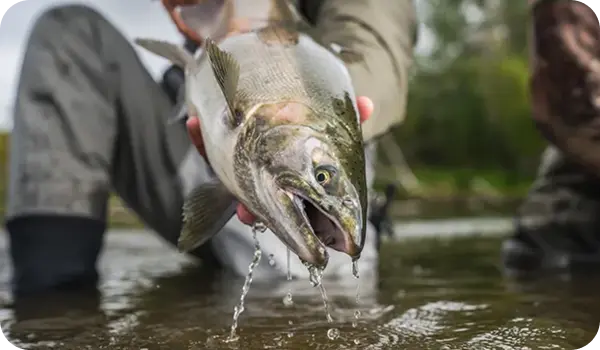
When landing and releasing a fish from shore, you need to keep the fish in at least a foot of water at all times. Never pull a fish up onto the beach. If you have to touch the fish you should first wet and/or wash your hands in the stream water to get any Muskol or other impurities off of them. You should gently grasp the fish by the tail and under the belly, making sure not to squeeze the fish. You should never grab a fish by the tail and hold him vertically as this separates their vertebras. The gills on a fish are very delicate and you should take special care not to touch them. Always keep the fish in the water. You should gently take the hook out and hold the fish with its head facing into the current until it swims away.

We do not allow fish pictures to be taken in the boats, because of the possibility of dropping the fish and causing injury. If we are floating and you want to take a photograph of a fish we will pull the boat over to shore. No photographs will be taken of fish from the boats unless it is of the fish in the water. We allow fish to be photographed, but discourage excessive photographing of fish.

When photographing a fish from shore, you should gently hold the fish in the water until the photographer has the camera focused and the light aperture set. Then quickly raise the fish from the water about six to eight inches; and once the picture is taken, immediately lower the fish back into the water and release it.

Out of respect, we do not allow photographing of fish when natives are present. Some natives feel that catch and release techniques, as well as photographing fish, go against a Y’upik religious belief that states that you should never play with a potential food source. Local Y’upik Eskimos view fish as thinking, feeling beings and a source of food. They believe that fish consciously give themselves to the angler and must be treated with respect. When a human touches a fish, some Y’upik’s believe that the fish has been polluted and must be retained for consumption

As we float down the river the guides will be constantly pointing out where the fish are “holding” and how to best present your fly or lure. It is best to have several rods set up, so that you can easily switch techniques for the various species that you will encounter throughout each day.

The cook and guides will get up at 5:30am each morning and will have coffee and fruit ready by 6:00am. We usually serve breakfast at 7:00am and are on the river by 8:00am. We bring along a deli-style lunch and have lunch on the river at 12:00pm. and usually go back to camp between 6:00 pm and 6:30 pm. We also have the option of doing a shore lunch where we have fresh fish on the river. Just let your guide know before you leave camp in the morning.

We strongly recommend that guests do not drink any water directly from the river. We provide purified water in the boats and in camp for you to drink. A variety of soft drinks are also available.

Each boat is equipped with Commercial Life Jackets. It is recommended that all guests wear them while in the boats or wading the water. Another option is to purchase a float coat, as they are more comfortable to wear for extended time periods. We require that every angler wear eye protection while fishing.

On the Kanektok, you will discover that there is no need to wade any deeper than your thighs. Not only is wading deeper dangerous, but it is detrimental to your goal, in that it scares the holding fish. If you use waders you should always wear a wading belt to keep water from getting in your waders if you trip or fall in the water. When you are wading, you should be very careful not to step in any spawning beds, as this could wash the salmon eggs down river. To avoid getting bumped by the boats, always exit the rafts on the up river side, and wait for the boats to come to a complete stop before attempting to get out. While the boats are under power the guests would sit down at all times.

In the twenty plus years Dave Duncan & Sons has been guiding trips throughout Alaska (including Kodiak Island) we have never had a serious bear problem or injury. None the less, we don’t ever want to experience one in the future, and this is why we need to talk about bear behavior and how to best avoid a confrontation with one. Like any animal found in the wild, a bear’s behavior can be unpredictable. But we have found that a little common sense goes along way.

Because the bears on the Kanektok are hunted in the Fall and Spring, they are usually afraid of people. Dave Duncan and Sons’ guests are not allowed to bring or carry firearms. We do see some bears throughout the summer, but rarely do we see them up close; and, we would like to keep it this way. The majority of bears that we have observed in Alaska wish to avoid close contact with people almost as much as we wish to avoid close contact with them. With this in mind, you should always talk loudly to one another, so that you don’t surprise a bear. Most reported bear attacks are the result of a bear being startled. The majority of bears will flee an area once they realize people are present.

Although it would be rare that a Dave Duncan and Sons’ guest would not have a guide present with them or very nearby, we would still like to talk about how to react if you were to encounter a bear while by yourself. Again, the best situation is to try to avoid any encounter at all by making noise (i.e. talk, clap, sing, or whistle to yourself etc...). Bears have a keen sense of hearing and would most likely leave the area upon hearing you.

The first and most important rule to remember in a bear encounter is to never turn your back on a bear, and never run. Because of the bear’s past associations with this behavior, it would be the bear’s natural instinct to pursue a fleeing or defenseless (back turned) animal. If you spot a bear at a distance that appears to be unaware of your presence, simply back away slowly, and get back to your group. Always let your guide know if you spot a bear, no matter how far away. If the bear is at a distance, aware of your presence, and starts to move towards you, it is best to repeatedly shout loudly at the bear (i.e. “Hey Bear!”). This usually scares the bear away. Also shouting, and including the word “bear” in your shouts, will let your guide know that a bear is nearby. If you are making noise or talking loudly, it would be unusual for you to encounter a bear at a close distance. However, if this were to happen, you should try not to make eye contact with the bear, and you should give the bear plenty of room to flee. Again, do not turn your back or run. Attempting to stay calm, and using common sense are really your best allies.

We are often asked what an appropriate tip is for the guides. This is a touchy issue for us as we feel that tipping is a personal subject. One guest’s idea of a good tip can vary greatly from another. We do not want you to feel obligated to tip a certain amount. With that said we can tell you that tips seem to average $250 to $300 per guest, with some guests tipping more. You can decide what you feel is appropriate and you can leave it with the camp manager at the end of your stay.

We hope you understand that we are here to help you in any way possible. While floating the river, please let us know if there is anything we can do to make your trip more enjoyable. You should not have to put up with leaky waders, broken zippers, etc. as we have the necessary equipment to fix or replace most items. If you have any questions for us after reading through all of this information, or if you simply want to talk fishing, please do not hesitate to give us a call.

For a printable version of this page click here


For more information or to make a reservation:
call (509)962-1060 or send e-mail info@alaskaflyfishingcamps.com
Copyright © 1996-2006 Dave Duncan & Sons, Ltd.